Why does your weight change so much day to day?
Water, glycogen, food in transit and salt move the scale far more than fat does. What a normal daily swing looks like, and how to read the number properly.
By Hammad ShahidLast updated
Why did my weight go up overnight?
Almost never because you gained fat. Day-to-day scale weight is dominated by water, stored carbohydrate, food still moving through your gut and salt intake, and swings of 1 to 2 kg (2 to 4 lb) between mornings are ordinary in healthy adults. Gaining a kilogram of actual fat takes a surplus of roughly 7,700 kcal, which is not something a single evening can do. Weigh under the same conditions and read the weekly average rather than any one morning.
What is the scale actually weighing?
Everything. A bathroom scale cannot separate fat from muscle, water, the food you ate last night or the coffee you just drank. It reports one number for the whole system, and on any given morning most of the movement in that number comes from the parts that are not fat.
| What moves | How fast |
|---|---|
| Water | Shifts with salt, heat, hormones, sleep and how much you drank. The largest single mover. |
| Stored carbohydrate | Glycogen holds water alongside it, so a high-carb day reads heavier the next morning. |
| Food and drink in transit | A large meal is still physically inside you for a day or more. It weighs what it weighs. |
| Waste not yet passed | Varies by hours and by how much fibre you ate. |
| Body fat | Changes slowly and steadily. Almost never what moved the number overnight. |
Why an overnight gain cannot be fat
The arithmetic settles this on its own. Gaining a kilogram of body fat takes a surplus of roughly 7,700 kcal, and a pound takes about 3,500. To gain a genuine kilogram of fat between Tuesday and Wednesday you would have to eat around 7,700 kcal above what you burned, in one day, on top of everything you normally eat.
A heavy meal out might put you 1,000 to 1,500 kcal above maintenance. That is real, and repeated often it matters, but as fat it is a couple of hundred grams at most. If the scale says you are 1.5 kg heavier the next morning, the other 1.3 kg is water, food and salt. It leaves again over the following days without you doing anything.
The clearest version of this runs inside a single day: you are reliably heavier in the evening than you were that morning, covered in do you weigh more at night than in the morning.
The same logic runs in reverse, which is the part people like less. A 2 kg drop in three days is not 2 kg of fat either. See how big a calorie deficit you actually need for what a realistic rate looks like.
Why carbs and salt move the number so much
Your body stores carbohydrate as glycogen, and glycogen holds water alongside it. Olsson and Saltin demonstrated in 1970 that total body water rises and falls with muscle glycogen, which is why a carbohydrate-heavy day shows up on the scale the next morning and why the first week of a low-carb diet produces a dramatic drop that then stops.
That early drop is frequently mistaken for rapid fat loss, and the plateau that follows is mistaken for failure. Neither reading is right. Both are glycogen and its water, moving out and then settling.
Salt works similarly over a shorter window. A high-sodium meal draws water into circulation and holds it there for a day or two. Restaurant food is usually far saltier than home cooking, which is a large part of why a meal out reads so heavily the next day.
Is there a normal weekly pattern?
Yes, and it has been measured. A 2014 study tracked daily weights in 80 adults across 4,657 measurements and found a consistent group-level rhythm: weight rises across the weekend, peaks on Sunday or Monday, and falls again from Tuesday onward.
The authors were explicit that this pattern should be treated as normal rather than as evidence of weight gain. More usefully, the people who showed the strongest weekday compensation were the ones most likely to lose or maintain weight over the long run. The rhythm is not a problem to eliminate; it is what ordinary eating looks like on a scale.
The practical consequence is simple. Comparing a Monday weight against a Friday weight will flatter you, and comparing Friday against Monday will alarm you. Neither comparison means anything. Compare like with like.
How much daily variation is normal?
For most healthy adults, 1 to 2 kg (roughly 2 to 4 lb) between mornings is unremarkable. Larger swings are common after a big meal, a salty one, hard training, a long flight or poor sleep.
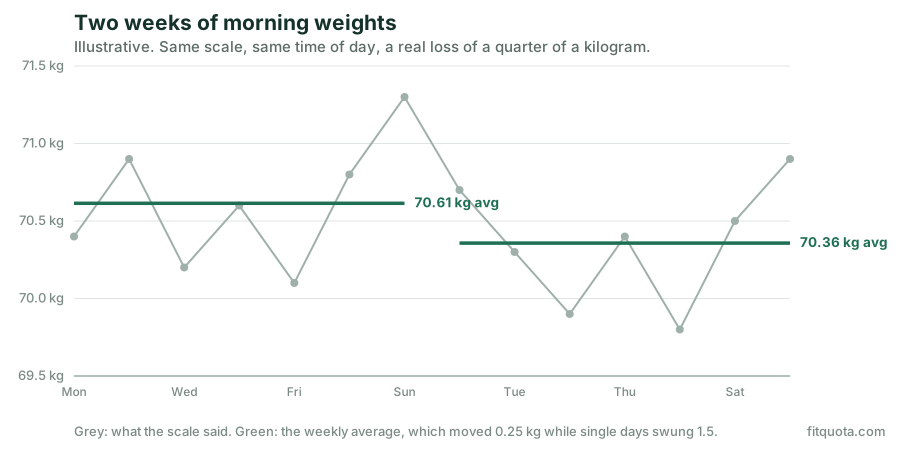
Across a week the range is wider, because the causes stack: a salty Saturday, a long run on Sunday and a short night before Monday can separate the highest and lowest morning of a week by 2 to 3 kg while your body fat is doing nothing at all. That is the case for reading a weekly average rather than any single morning, which the last section of this guide sets out.
Bigger bodies tend to show bigger absolute swings, simply because there is more water in the system to move. If your daily variation looks large in kilograms, check it as a percentage of your body weight before concluding anything is unusual.
What is worth attention is a sudden, sustained gain of several kilograms over a few days accompanied by swelling or breathlessness. That is a reason to speak to a doctor rather than to adjust your calories.
Can your weight fluctuate 5 pounds in a day?
Yes, and it is more common than people expect. Five pounds is 2.3 kg, which is at the top of the ordinary range rather than outside it. It takes a day with a large meal, plenty of fluid and more salt than usual, and it is entirely water and food in transit.
The arithmetic settles what it cannot be. Storing 2.3 kg of fat requires eating roughly 17,700 kcal more than you burned. Nobody does that in a day. What you are seeing is mass that is passing through you, and most of it will be gone within 48 hours.
Two things make a 5 lb swing more likely: being heavier to start with, because there is more water in the system to move, and eating substantially more salt than the day before, which the section above explains. If it happens repeatedly and does not come back down, that is a different conversation, and it is one for a doctor.
Does your weight fluctuate during your period?
Yes, but by less than the internet claims. When 42 women were weighed twice a week through a full cycle, body weight during menstruation averaged 0.45 kg higher than in the first week of the cycle, and almost all of that was extracellular water rather than anything you ate.
That is around one pound. Individuals vary either side of the average, and some people genuinely notice more, but if you are looking for an explanation for three or four kilograms, this is not it. The other causes on this page will be doing most of that work.
The practical answer is to compare like with like: the same week of your cycle against the same week of the previous one, rather than the week before your period against the week after it. Energy needs themselves barely move across the cycle, which is TDEE different for women covers with the evidence.
How should I weigh myself so the number means something?
You cannot remove the noise, but you can stop it moving around. Four rules do most of the work:
- Same time, same conditions. First thing in the morning, after using the bathroom, before eating or drinking, wearing the same amount.
- Weigh often, not rarely. Daily weighing feels worse but produces a better average. Weighing once a week means one noisy reading stands in for the whole week.
- Read the weekly average, never a single morning. Compare this week's average against last week's. Any app that shows a trend line is doing exactly this.
- Give it two to three weeks. That is roughly the shortest window in which a real trend separates itself from ordinary variation.
What to measure instead of this morning
Three numbers are worth more than any single reading, and none of them move with your water balance:
- Your maintenance level. What you burn in a day is the figure a target is built from. The TDEE calculator estimates it and shows the arithmetic.
- Your intake target. A deficit you chose deliberately beats one that happens by accident. The calorie calculator sets it against your maintenance level.
- Something that is not the scale at all. Waist measurement, how clothes fit, or what you can lift. A one rep max that keeps climbing while the scale sits still is progress the scale cannot show you.
So when is a change actually real?
When the weekly average moves in one direction for two or three weeks running. That is the signal. Everything shorter is noise, and treating noise as signal is how people end up cutting calories further in a week where nothing was wrong.
If the average genuinely is not moving after three weeks of consistent eating, then your real maintenance level is lower than the estimate you started from. Adjust by 100 to 200 kcal and give it another few weeks. You can re-run the numbers in the Calorie Calculator, which shows every step of the arithmetic so you can see exactly which input moved your target.
Sources
That body weight follows a weekly rhythm, rising across the weekend and falling again through the week, and that this pattern is normal rather than a sign of weight gain.
Orsama AL, Mattila E, Ermes M, et al. Weight rhythms: weight increases during weekends and decreases during weekdays. Obes Facts. 2014;7(1):36-47.
View sourceThat total body water rises and falls along with muscle glycogen, which is why carbohydrate intake moves scale weight independently of fat.
Olsson KE, Saltin B. Variation in total body water with muscle glycogen changes in man. Acta Physiol Scand. 1970;80(1):11-18.
View sourceThat body weight during menstruation averaged 0.45 kg higher than in the first week of the cycle, almost entirely from extracellular water, in 42 women weighed twice weekly.
Kanellakis S, Skoufas E, Simitsopoulou E, et al. Changes in body weight and body composition during the menstrual cycle. Am J Hum Biol. 2023;35(11):e23951.
View sourceThat the 3,500-kcal-per-pound rule overpredicts real weight loss, because it assumes a fixed body composition and an energy expenditure that does not fall as you lose weight.
Hall KD. What is the required energy deficit per unit weight loss? Int J Obes (Lond). 2008;32(3):573–576.
View source
Run the numbers for yourself
This calculator will help you estimate your daily calorie target based on factors like age, sex, weight, height, activity level, and goal. Results are useful starting points for meal planning, not precise prescriptions.
Open the Calorie CalculatorRelated guides
Guide
How big a calorie deficit do you actually need?
What a calorie deficit is, the arithmetic behind losing 1 lb or 0.5 kg a week, and why the familiar 3,500-calorie rule overpromises.
Read guideCalorie Calculator
Guide
What are maintenance calories?
Maintenance calories are the intake that holds your weight steady. How to estimate the number, and how to find your real one from the scale.
Read guideTDEE Calculator
Guide
When is the best time to weigh yourself?
First thing in the morning, after the bathroom, before eating. Why that time wins, how often to step on, and how to read what you get.
Read guideBMI Calculator
Guide
Do you weigh more at night than in the morning?
Yes, usually by 1 to 2 kg (2 to 4 lb), and none of it is fat. The arithmetic of what you carry through a day, and where it goes overnight.
Read guideBMI Calculator