Do you weigh more at night than in the morning?
Yes, usually by 1 to 2 kg (2 to 4 lb), and none of it is fat. The arithmetic of what you carry through a day, and where it goes overnight.
By Hammad ShahidLast updated
Do you gain weight during the day?
Yes, and it is not fat. Everything you eat and drink physically weighs something the moment it is inside you: a litre of water weighs exactly one kilogram before your body has done anything with it. Across a normal day most people take in more mass than they pass, so weight climbs from morning to evening, commonly by one to two kilograms. It comes off again overnight through urine, sweat and the water you exhale while sleeping, which is why weighing first thing after the bathroom is the convention.
Why the number climbs through the day
Nothing mysterious is happening. A bathroom scale weighs everything that is currently part of you, and that includes the sandwich you ate an hour ago and the water still working its way through your system.
A litre of water weighs one kilogram. That is not an approximation, it is roughly how the kilogram was defined. So drinking a large glass of water and stepping straight back on the scale will show you half a kilogram heavier, immediately, before your body has done anything at all with it.
| What goes in over a day | Weighs |
|---|---|
| Two litres of drinks | 2.0 kg |
| A day of food | about 1.5 kg |
| Total carried at some point in the day | about 3.5 kg |
You are also losing mass all day through the bathroom, through sweat and through breathing. Intake and output do not run at the same rate, though. Most people take in more than they pass during waking hours, which is why the number drifts upward until bedtime and typically peaks in the evening.
How many kg heavier are you at night?
For most people the evening reading is 1 to 2 kg above the morning one, which is 2 to 4 lb. The gap follows directly from the sum above: roughly 3.5 kg goes in across the day and rather less than that comes out before bedtime.
| Morning to evening | Difference | In pounds |
|---|---|---|
| An ordinary day | 1 to 2 kg | 2 to 4 lb |
| A large or salty meal, or a lot of fluid | up to about 2.5 kg | up to about 5.5 lb |
| A light day with little food and drink | under 1 kg | under 2 lb |
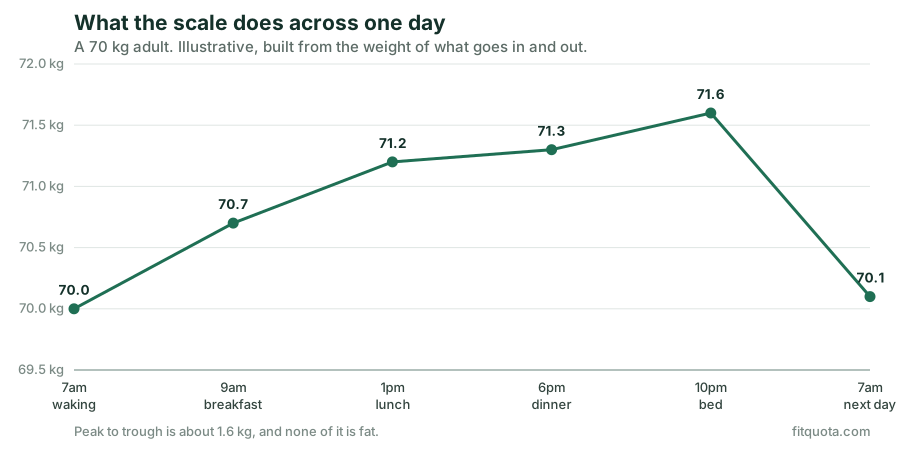
Bigger people swing more, because they eat and drink more to begin with. The figure also grows on a day with a lot of salt, which holds water in the body for a while, and on a day you train hard and drink through it.
None of this is a measurement of you. It is a measurement of what is currently inside you, which is why the same person can be 1 kg apart on two evenings that were identical in every way that matters.
How much of it is fat?
None of it, and the arithmetic settles this rather than an opinion. Storing a kilogram of body fat requires eating roughly 7,700 kcal more than you burned. To genuinely gain a kilogram of fat between breakfast and bedtime you would have to eat about 7,700 kcal above maintenance in a single day, on top of everything you normally eat.
A large, indulgent day might put you 1,000 to 1,500 kcal above maintenance. As fat, that is around 130 to 195 grams. Meanwhile the scale may be showing you two kilograms heavier. The gap between those two figures is food, drink and water sitting inside you, and it is leaving again shortly.
That comparison only works if you know what maintenance is for you. The TDEE calculator gives you the figure, and anything the scale does above or below it in a single day is almost certainly water rather than fat.
Where does it go overnight?
Three routes, running all night while you do nothing:
- Urine. The single largest overnight loss, and the reason the first trip to the bathroom changes the reading noticeably.
- Breathing. Exhaled air carries water vapour. You lose a surprising amount of mass simply by breathing for eight hours, which is also how the carbon from burned fat physically leaves your body.
- Sweat. Even in a cool room, and more in a warm one.
That is why a morning weight is lower than the previous evening without anything meaningful having happened. It is also why sleeping in a hot room can make you look like you lost half a kilogram overnight. You lost water, and you will drink it back before lunch.
So when should you weigh yourself?
First thing in the morning, after using the bathroom, before eating or drinking. Not because that number is more true than any other, but because it is the most repeatable point in the day. Everything after it depends on when you last ate, drank or used the bathroom.
What matters far more than the time is that it is always the same time. Comparing a Tuesday morning to a Friday evening tells you nothing except that you ate dinner on Friday.
And once you are weighing consistently, read the weekly average rather than any single reading. Day to day the number still moves for reasons that have nothing to do with fat, which is covered in why your weight changes day to day.
What this means if you are tracking
Stop weighing yourself in the evening and being disappointed. You are measuring your dinner.
It also explains a specific trap. People start a calorie deficit, weigh themselves at a random moment a few days in, see a number higher than the one they remember, and conclude the deficit is not working. Usually they have compared a morning reading to an evening one, or a fasted reading to a post-meal one. The deficit was fine. The measurement was not.
Sources
That the 3,500-kcal-per-pound rule overpredicts real weight loss, because it assumes a fixed body composition and an energy expenditure that does not fall as you lose weight.
Hall KD. What is the required energy deficit per unit weight loss? Int J Obes (Lond). 2008;32(3):573–576.
View sourceThat body weight follows a weekly rhythm, rising across the weekend and falling again through the week, and that this pattern is normal rather than a sign of weight gain.
Orsama AL, Mattila E, Ermes M, et al. Weight rhythms: weight increases during weekends and decreases during weekdays. Obes Facts. 2014;7(1):36-47.
View source
Run the numbers for yourself
This calculator will help you estimate your BMI category (underweight, normal, overweight, or obese). BMI is a general population metric and does not account for muscle mass, body composition, or individual health factors.
Open the BMI CalculatorRelated guides
Guide
Why does your weight change so much day to day?
Water, glycogen, food in transit and salt move the scale far more than fat does. What a normal daily swing looks like, and how to read the number properly.
Read guideCalorie Calculator
Guide
How big a calorie deficit do you actually need?
What a calorie deficit is, the arithmetic behind losing 1 lb or 0.5 kg a week, and why the familiar 3,500-calorie rule overpromises.
Read guideCalorie Calculator